
The 60-Second Desk Upgrade: Why Exercise Snacks Are a Game-Changer for Office Workers
Good evening everyone! Tonight in my free time, I was reading a bunch of exercise physiology papers about something called exercise snacks.
If you work a desk job like me—staring at SQL queries, Python scripts, and dashboards for eight or nine hours a day—you probably know the dreaded 15.00 wall. Your eyelids get heavy, your brain turns to mush, and suddenly ordering another kopi susu feels like a survival requirement.
Not gonna lie, I used to think hitting the gym or working out after office hours canceled out all that sitting. Turns out, human biology does not work like that. As usual, I need to record a lot of stuff so I can remember it properly, so here is what I learned about why 60-second movement bursts might be the best desk upgrade for office workers.
1. The “Active Couch Potato” Trap 🪑
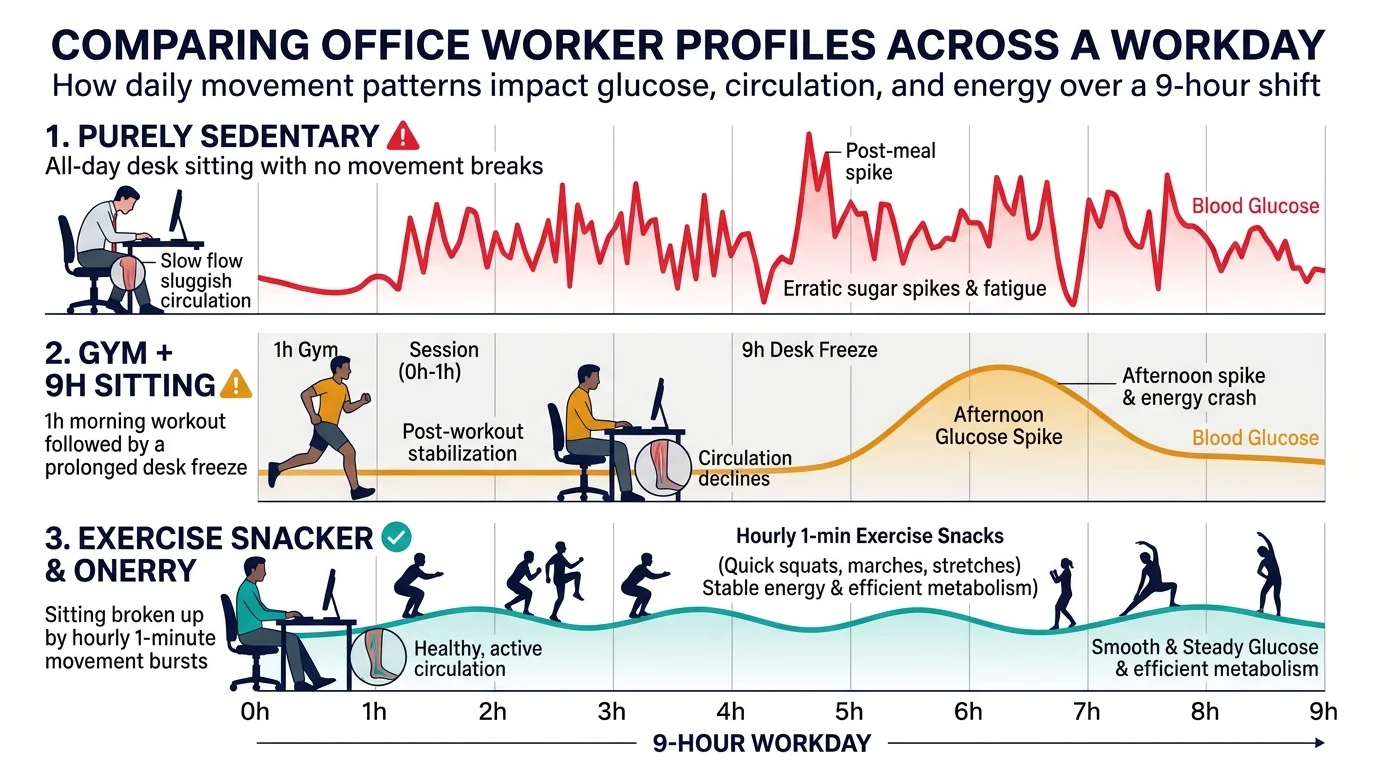
Researchers have a funny but slightly terrifying term for people who work out for an hour at night yet sit in a chair all day: the Active Couch Potato.
Within just 30 to 60 minutes of uninterrupted sitting, your body enters metabolic hibernation. Your glutes and quads—the biggest glucose-burning muscles you own—go completely offline. Blood flow in your legs slows down because of the bent hip and knee angles, and lipoprotein lipase (LPL), the enzyme that clears fat from your bloodstream, drops sharply.
Extra Example: Think of it like a Dota 2 carry who AFK-farms the jungle for 40 minutes while the enemy team takes every tier-two tower, then tries to solo-push mid at minute 45. One big burst of effort at the end of the day does not erase 40 minutes of zero map pressure.
This is where exercise snacks come in. Instead of one big workout, you sprinkle planned 15-to-60-second bursts of vigorous movement across your workday with 1 to 4 hours of recovery in between. No gym bag, no warm-up, and no sweat-soaked office shirt required.
How Exercise Snacks Compare to Traditional Workouts for Busy Professionals
| Feature | Exercise Snacks (ES) | VILPA (Incidental Bursts) | Traditional 60-Min Gym Workout |
|---|---|---|---|
| Time Commitment | 3 to 8 minutes total/day (broken into 45–60s bursts) | 3 to 5 minutes total/day (unplanned daily rushes) | 60 to 90 minutes (including commute & shower) |
| Structure & Timing | Intentional micro-breaks every 1–2 hours or before meals | Sporadic (rushing for a train, carrying heavy boxes) | Single continuous block before or after work |
| Effect on All-Day Sitting | Directly reverses seated metabolic & vascular freeze | Partially interrupts sitting when bursts occur | Does not prevent 8–10 hour daytime glucose/blood flow dips |
| Sweat & Wardrobe Impact | Zero sweat—doable in smart-casual office wear | Minimal to moderate | Full workout gear and post-session shower required |
| Primary Superpower | Flatlines post-lunch blood sugar spikes, boosts $\dot{V}\text{O}_{2\text{peak}}$, preserves focus | Slashes cardiovascular & all-cause mortality risk | Builds maximal strength, hypertrophy, and endurance |
2. Killing the 3 PM Brain Fog & Glucose Crash 🧠
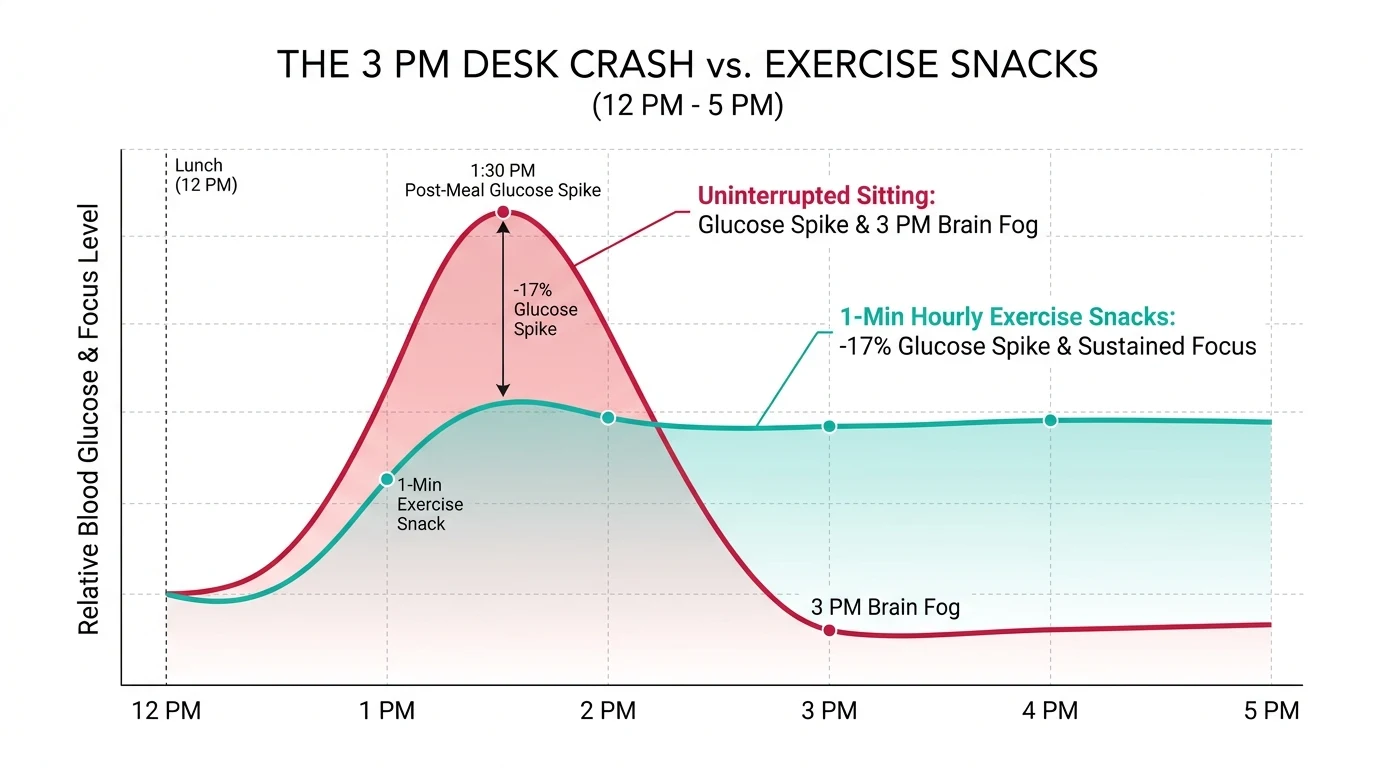
That 3 PM brain fog is usually not a caffeine deficiency—it is a post-lunch traffic jam in your bloodstream. When you eat lunch and immediately sit back down for an afternoon call, digested glucose floods your blood while your resting leg muscles keep their cellular doors locked.
Your pancreas panics and pumps out a massive wave of insulin, causing a blood sugar spike followed by a crash. Breaking up sitting with just 60 seconds of movement flips three biological switches:
A. Insulin-Free Glucose Sponge (GLUT4)
A brisk 60-second burst of squats or stairs recruits fast-twitch muscle fibers and activates AMPK signaling. This physically pushes GLUT4 transporters to the surface of your muscle cells so they soak up blood sugar without needing extra insulin, flattening post-meal glucose spikes by up to 17%.
B. Mitochondrial Wake-Up Call ($\text{PGC-1}\alpha$)
Your cellular energy factories do not care if you trained for an hour—they respond to the peak rate of energy demand. Pushing hard for 45 to 60 seconds activates $\text{PGC-1}\alpha$, the master switch that triggers mitochondrial biogenesis.
C. Your Calves Are a “Second Heart”
Your calf muscles act as a venous pump. Sixty seconds of calf raises or stair climbing restores healthy blood flow in your leg arteries, keeps $\text{LPL}$ enzymes active, and sends a fresh pulse of oxygen and brain-derived neurotrophic factor ($\text{BDNF}$) straight to your brain.
3. The Data: What 4 Minutes a Day Actually Does 📊
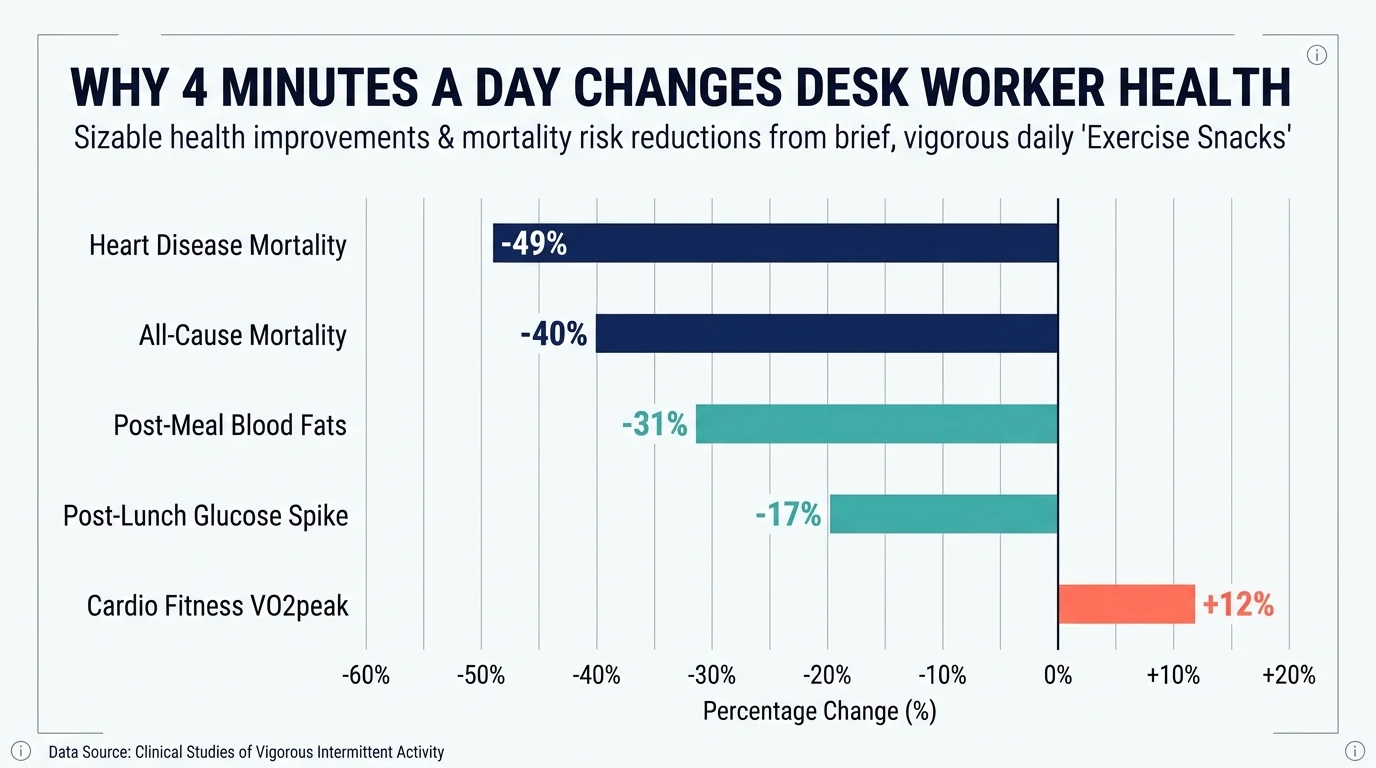
Since I look at data all day, I wanted to see the actual numbers behind this—not just wellness hype. Across randomized controlled trials and massive wearable-tracker cohorts, the results are honestly wild:
| Study | Who Was Tested | Snack Protocol | Key Result |
|---|---|---|---|
| Stamatakis et al. (2022) | 25,241 non-exercising adults | $\ge 3$ bursts/day of 1–2 min (~4.4 min/day) | -49% CVD mortality & -40% all-cause mortality |
| Francois et al. (2014) | Adults with insulin resistance | $6 \times 1\text{-minute}$ bursts 30 min before meals | -17% breakfast & -13% dinner glucose spikes |
| Jenkins et al. (2019) | Inactive office-aged adults | $3 \times 20\text{-second}$ stair climbs, 3x/week | +12% peak power & +5% $\dot{V}\text{O}_{2\text{peak}}$ in 6 weeks |
| Moore et al. (2022) | Adults sitting 7.5 hours | 15 bodyweight squats every 30 min | Keeps muscle protein synthesis switched on |
In the Francois et al. (2014) study, six 1-minute bursts spread before meals actually beat a single continuous 30-minute workout for controlling 24-hour blood sugar.
Note: Recent 2025–2026 meta-analyses point out two important caveats. First, intensity matters—you have to move fast enough during those 60 seconds to breathe noticeably hard (around a 7 to 9 out of 10 effort). Second, exercise snacks are a metabolic floor, not a replacement for heavy lifting if your goal is building serious muscle mass.
4. Five Office-Friendly Snacks (No Sweat, No Floor Contact) 🏢
Nobody wants to do burpees on a dusty office carpet in smart-casual pants. Here are five zero-equipment snacks that pass the workplace dignity test:
A. The Stairwell Sprint (20–45 seconds)
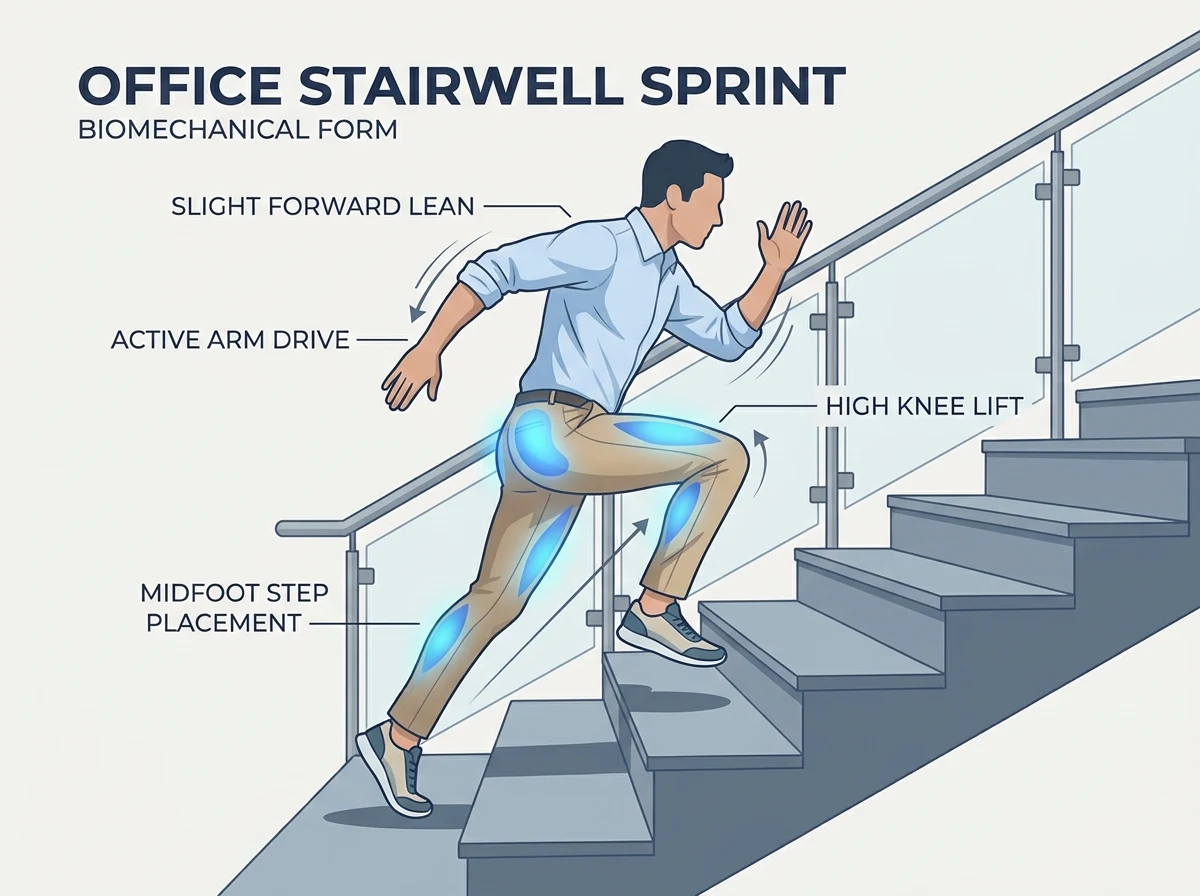
Walk briskly or jog up 3 to 6 flights of stairs (60 to 120 steps), then walk back down slowly to recover. Lean slightly forward, plant your midfoot on each step, and pump your arms. Do this 3 times a day and you hit the exact protocol from the Jenkins study.
B. Chair Sit-to-Stand Squats (15–20 reps)
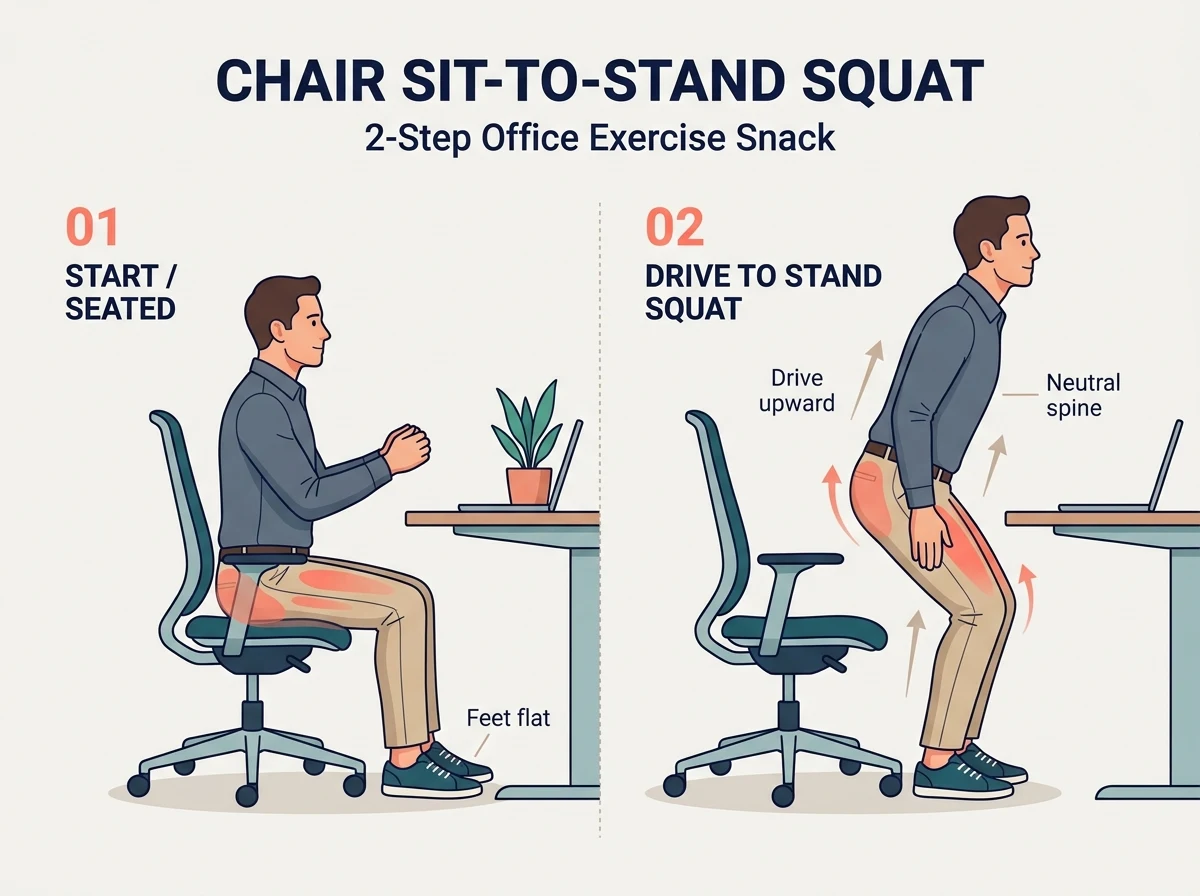
Stand in front of a stationary chair (please lock or avoid your rolling swivel chair unless you want to fly across the room). Push your hips back, lightly tap the seat, and stand up fast. Doing 15 to 20 reps takes about 45 seconds and lights up your quads and glutes.
C. Incline Desk Push-Ups (12–20 reps)
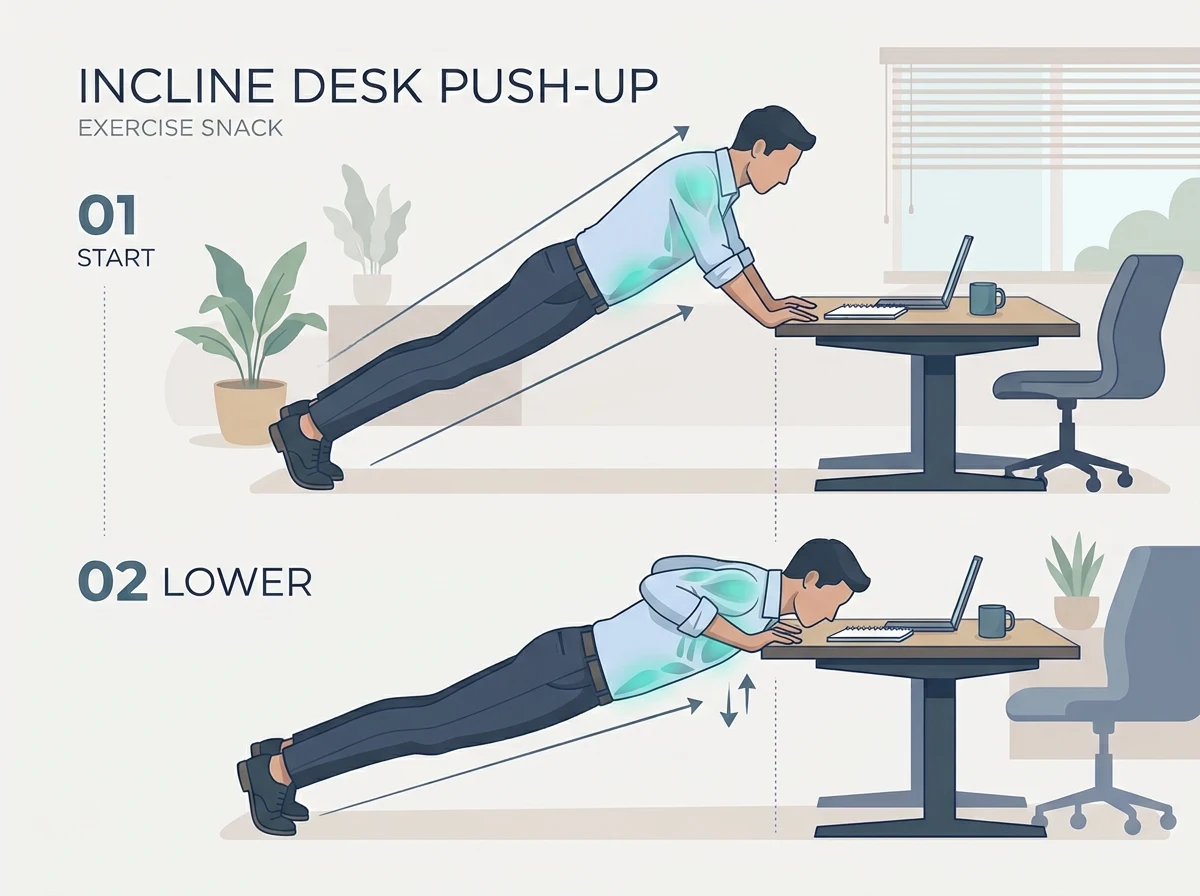
Place your hands slightly wider than shoulder-width on a heavy desk or breakroom kitchen counter. Keep your body straight, tuck your elbows at a $45^\circ$ angle, and knock out 15 crisp reps while waiting for the coffee machine.
D. Standing Doorframe Rows (15 reps)
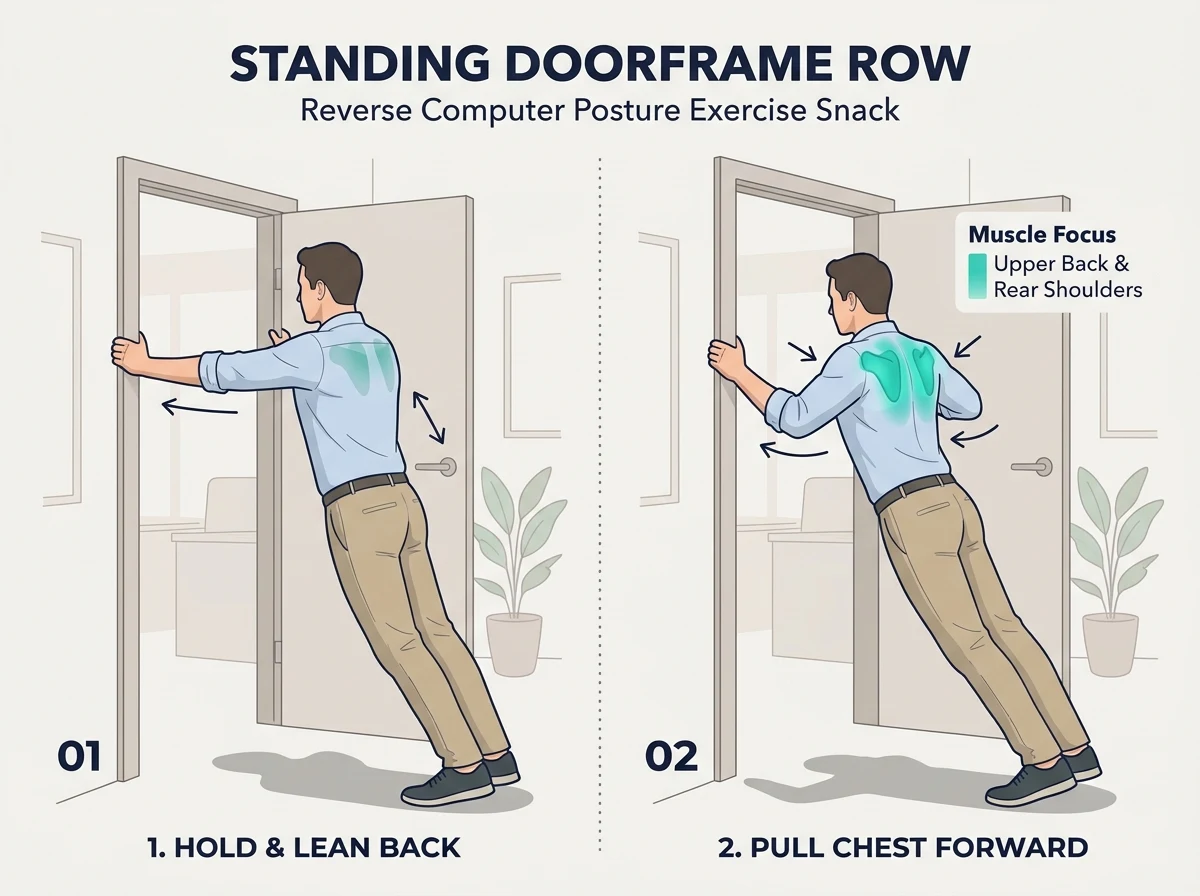
Stand facing an open doorway, grab both sides of the frame at chest height, lean back with straight arms, and pull your chest toward the frame by squeezing your shoulder blades together. This is the ultimate antidote to laptop hunchback.
E. High-Knee Marches + Calf Raises (60 seconds)
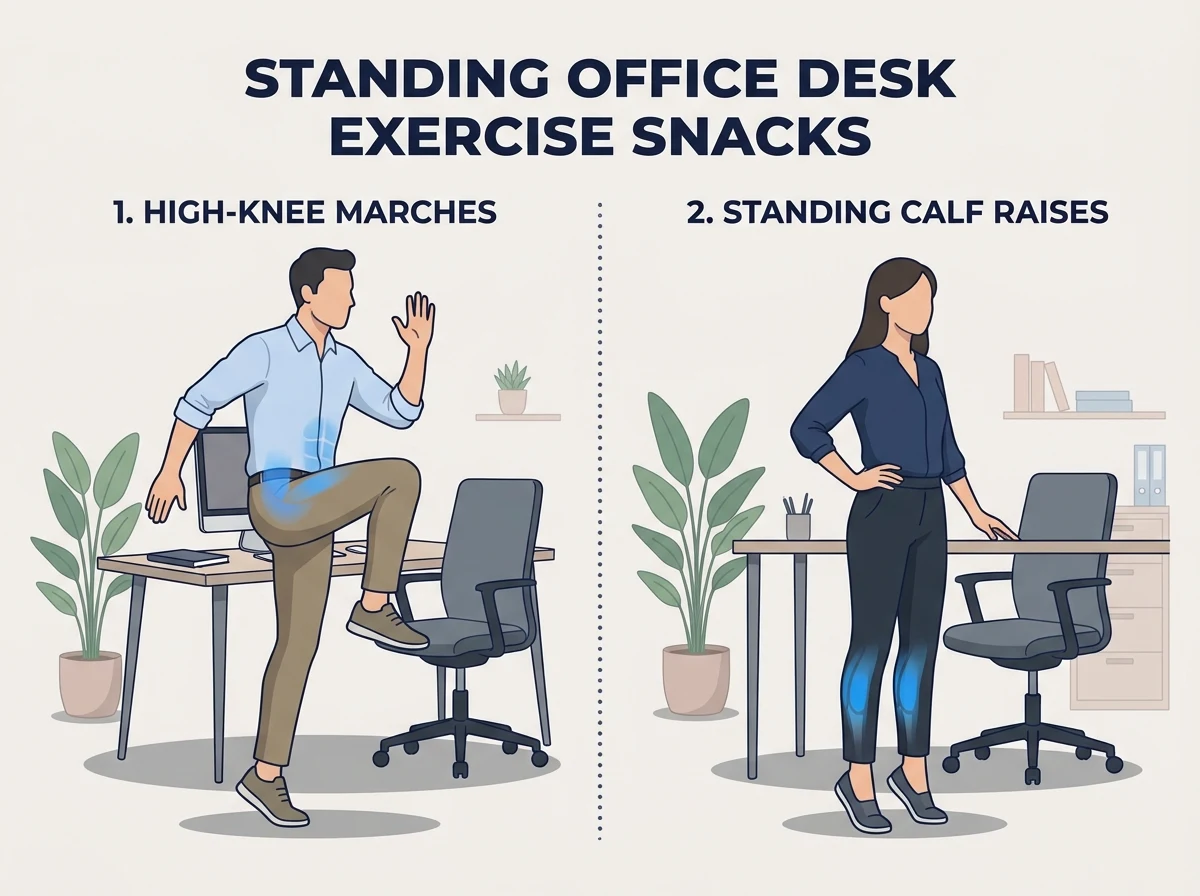
If you are stuck behind a cubicle or standing desk, do 30 seconds of brisk high-knee marches followed immediately by 30 seconds of fast tiptoe calf raises. Completely silent, zero impact, and stealthy.
5. How I’m Actually Applying This (Habit Triggers) ⚙️
Setting hourly phone alarms sounds great in theory, until you are deep in debugging a query and dismiss five alarms in a row. Borrowing a page from habit-stacking books, it is much easier to attach each 60-second snack to an existing office cue:
- The “Leave Meeting” Trigger: Every time I click Leave on a virtual meeting, I stand up immediately and do 15 chair squats before opening Slack or email.
- The Coffee & Water Tax: Never stand around scrolling on your phone while waiting for water to boil or coffee to brew—knock out 15 incline counter push-ups instead.
- The Two-Flight Detour: Whenever I walk to the restroom, I take the stairs two extra flights up and back down before heading back to my desk.
One quick safety tip: since you are going straight from a cold chair into vigorous effort, use the first 10 seconds of every snack to warm into the pace before pushing hard.
Conclusion: Start With Just One 60-Second Burst Today
You do not need an empty 90-minute block on your calendar or a fancy gym membership to protect your heart, sharpen your afternoon focus, and fix what all-day sitting does to your metabolism. Just four to six minutes of intentional, vigorous movement broken into 60-second chunks across your shift already captures a huge share of the health benefits.
Right after you finish reading this post, stand up from your chair and knock out 15 squats or climb two flights of stairs—your 3 PM brain will thank you.
That’s all for today, folks! Thanks for reading. I’ll catch you in the next post.
“Walking is man’s best medicine.”
– Hippocrates
Read next
-
 Related
The 1-Hour Morning Deep Work Routine That Actually CompoundsYou don't need a 12-hour hustle to build your own thing. Here is how 1 focused hour every morning—paired with modern leverage—adds up to 365 hours ...
-
 Related
My Curated Reading List: 30 No-Fluff Blogs for Data and Self-ImprovementA personal directory of 30 independent, ad-light blogs covering discipline, psychology, Python, SQL, Excel, Tableau, FOSS tools, and practical prom...
-
Related How to enjoy lifeSix practical lessons on living a good, ordinary life from 16th-century philosopher Michel de Montaigne—the guy who basically invented blogging fro...
-
 Related
Getting Things Done (GTD) with Cal NewportDavid Allen's GTD is great for clearing your head, but terrible for deep focus. Here is how Cal Newport's time-blocking and WIP limits fix it.
-
 Related
PART II: HOW TO IMMERSE YOURSELF IN BOOKS AGAINStruggling to finish a single page without checking your phone? Here is why our attention spans are fried and two dead-simple ways to fix your read...
-
 Related
How to Research Anything (Even When You Have a Full-Time Job)You don't need a PhD or endless free time to do deep research. Here is a practical system to scope questions, filter sources, and actually finish w...
-
 Reader favourite
Dota 2 Patch 7.42 : Item Potency, 15-Minute Tormentors, and Day 1 Meta ShiftsDota 2 Patch 7.42 kills passive high-ground stalling, nerfs spell burst, and adds Item Potency. Here is a full breakdown plus Day 1 pick and win ra...
-
Reader favourite Predicting BBRI Stocks with Meta’s ProphetThe IHSG so shit recently not gonna lie/ Have you ever wondered how businesses predict future sales, how weather apps forecast the temperature, or ...
Leave a comment