
Getting Things Done (GTD) with Cal Newport
Hello everyone! Tonight in my free time, I want to write down some notes on productivity—mostly because I need to record a lot of stuff so I can remember it properly, and also because my to-do list has been getting a bit out of control lately.
If you have ever fallen down the productivity rabbit hole, you have definitely heard of Getting Things Done (GTD) by David Allen. Its core rule is famous for a reason:
“Your mind is for having ideas, not holding them.”
– David Allen
By capturing every open loop—every bug to fix, email to reply to, or random script idea—into external lists organized by context (@Computer, @Office, @Calls), GTD eliminates that nagging background anxiety of forgetting something important.
Not gonna lie, the capture habit is awesome. Yet for engineers, data analysts, and researchers, pure GTD often hits a brick wall. Cal Newport—author of Deep Work and Slow Productivity—has spent years dissecting why classic GTD struggles in modern knowledge work, and how we can combine GTD’s capture engine with stricter execution controls.
1. The Flaw in Pure GTD: The Infinite To-Do Queue
Here is the catch: GTD is a capture and organization system, not a capacity or attention management system.
When you capture every Whatsapp message, ad-hoc data request, and side-project idea into a clean GTD list, two problems sneak up on you:
- Unbounded Work-in-Progress (WIP): GTD makes it so frictionless to say “yes” to small tasks because your system handles storing them. Over time, your
Next Actionslist balloons into hundreds of minor items. - Fragmented Attention: GTD encourages checking your context lists whenever you have a spare 15 minutes. For analytical or coding work, jumping between small tasks destroys cognitive momentum and leaves zero uninterrupted blocks for Deep Work.
Extra Example: Imagine trying to build an end-to-end machine learning pipeline, but every 15 minutes you stop to answer an email, rename a column in an old spreadsheet, and check a Jira ticket. By 5 PM, you are completely exhausted, you checked off 12 tiny items, and your actual model hasn’t moved an inch.
2. Cal Newport’s Hybrid Architecture
Rather than throwing GTD in the trash, Newport keeps GTD’s capture discipline and wraps it inside three stricter constraints:
A. Multi-Scale Planning (Quarter → Week → Day)
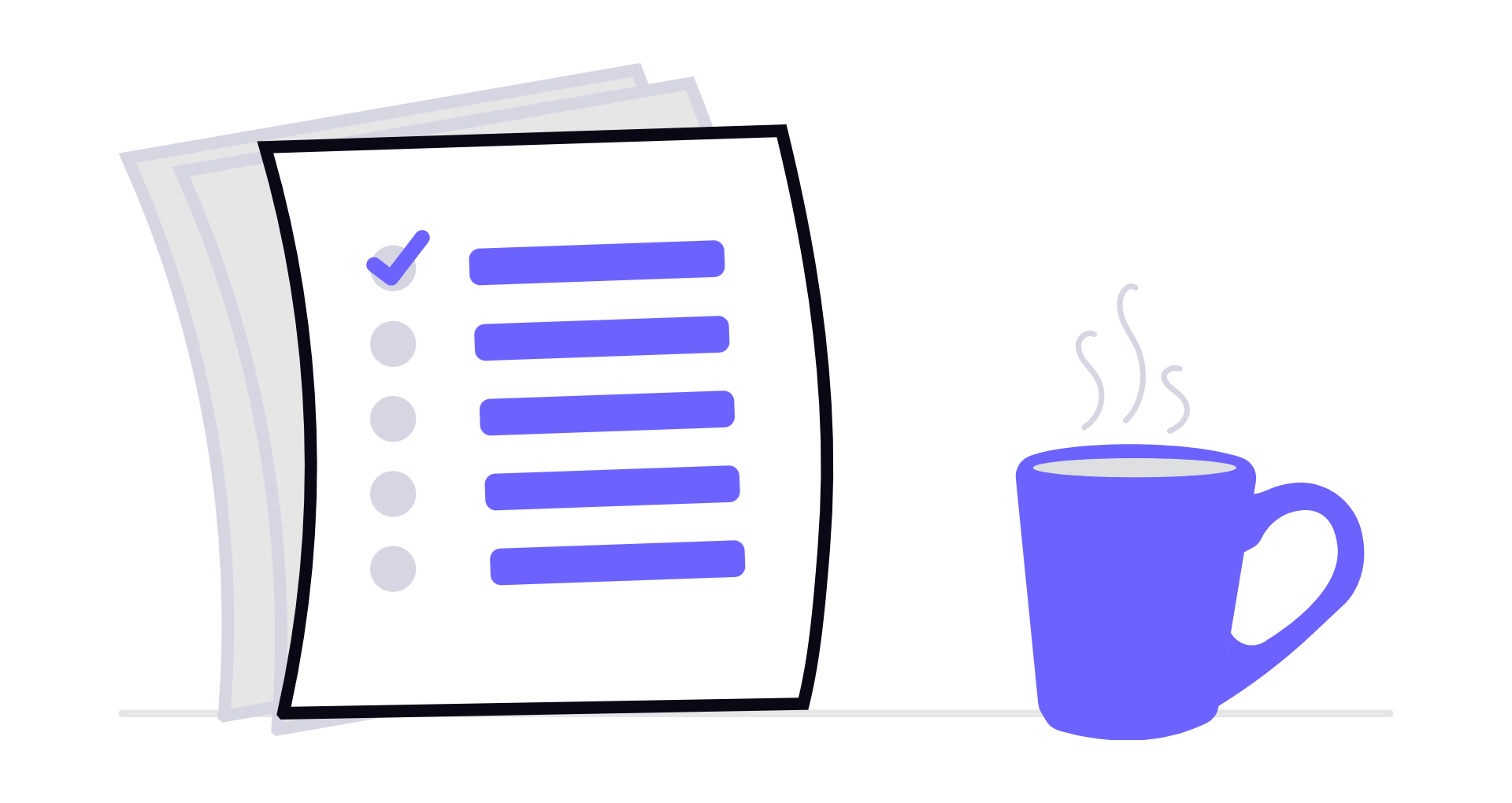
Instead of working bottom-up from an endless list of tasks, you plan top-down:
- Quarterly: Define 2–3 major objectives that actually move the needle.
- Weekly: Review your GTD lists once a week, pick the specific tasks required for your quarterly goals, and ruthlessly defer or delete the rest.
- Daily: Build a concrete Time-Block Plan before the workday starts.
B. Time-Blocking Over List-Picking
In pure GTD, you stare at a context list and ask, “What should I do right now?” Every time you finish a task, you burn willpower deciding what to pick next.
In Newport’s system, every hour of your workday is assigned a specific job in advance:
- Deep Work Blocks (90–180 mins): Reserved for hard cognitive tasks (writing code, designing data schemas, debugging complex logic) with zero chat or email notifications.
- Shallow Batch Blocks (30–60 mins): Dedicated windows to blitz through standard GTD
@Email,@Admin, and@Callstasks all at once.
C. Strict WIP Limits (“Pull” vs. “Push”)
Borrowing from Lean manufacturing, Newport advises separating your GTD projects into two buckets:
- Active Queue (Strictly Capped at 3–5 items): The only projects you are allowed to schedule onto your daily time blocks.
- Holding Tank (Unlimited): Everything else you captured via GTD. New tasks cannot enter the Active Queue until an existing project is finished.
3. Other Popular Frameworks That Back This Up
What I find interesting is that Cal Newport isn’t alone here. Several other well-known productivity thinkers arrived at the exact same conclusion—that capturing everything without strict limits leads to burnout:
- Oliver Burkeman (Four Thousand Weeks) & The “Open/Closed” List: Burkeman points out that GTD’s promise of “clearing the decks” is a trap—the faster you clear small tasks, the more people hand you new ones. His fix mirrors Newport’s WIP limit: keep two lists—an unlimited Open List (your GTD Holding Tank) and a Closed List capped at 10 items max. You cannot move a new task onto your Closed List until you finish or drop one.
- Personal Kanban (Jim Benson): Originating from Toyota’s manufacturing floor, Kanban’s number one rule is “Stop starting, start finishing.” Visualizing your tasks in
Backlog→Doing (Max 3)→Doneforces you to confront your real capacity instead of pretending you can juggle 20 active projects at once. - Tiago Forte’s PARA Method (Building a Second Brain): Forte actually worked closely with GTD principles before creating PARA (Projects, Areas, Resources, Archives). His key upgrade to GTD is separating actionable projects (which have a clear deadline and outcome) from reference knowledge, so your task manager doesn’t turn into a cluttered graveyard of “someday maybe” articles and notes.
4. Summary Workflow: Putting It All Together
If you want to run this hybrid setup starting tomorrow, the daily loop looks like this:
- Capture (GTD): Dump every commitment, bug, and random idea into an inbox immediately so your brain stays clear.
- Clarify & Cap (GTD + WIP Limit / Burkeman’s Closed List): Delete non-essential tasks. Put top priorities into your capped Active Queue (3–5 projects); park everything else in a Holding Tank.
- Time-Block (Newport): Assign your Active Queue tasks to specific hours on your calendar—protecting morning blocks for deep analytical work and batching shallow GTD tasks into one afternoon block.
- Shutdown Ritual (Newport): At the end of the day, sweep any loose ends back into your GTD inbox, sketch tomorrow’s time blocks, and completely disconnect.
Conclusion: Stop Managing Lists, Start Protecting Hours
GTD is still one of the best capture habits ever invented, so don’t stop writing things down. Just remember that a well-organized list of 200 tasks is still 200 tasks you don’t have time to do.
Actionable takeaway: Tonight, look at your current to-do list, pick at most 3 active projects for this week, hide the rest in a “Holding Tank” folder, and block out your first 90-minute Deep Work session on tomorrow’s calendar before you go to sleep.
“What we choose to focus on and what we choose to ignore—plays in defining the quality of our life.”
– Cal Newport
Leave a comment