
How to Research Anything (Even When You Have a Full-Time Job)
Hello everyone! Tonight in my free time, I want to share a system for researching literally anything—even when you are juggling a 9-to-5 job, errands, and only have scattered hours left in the evening.
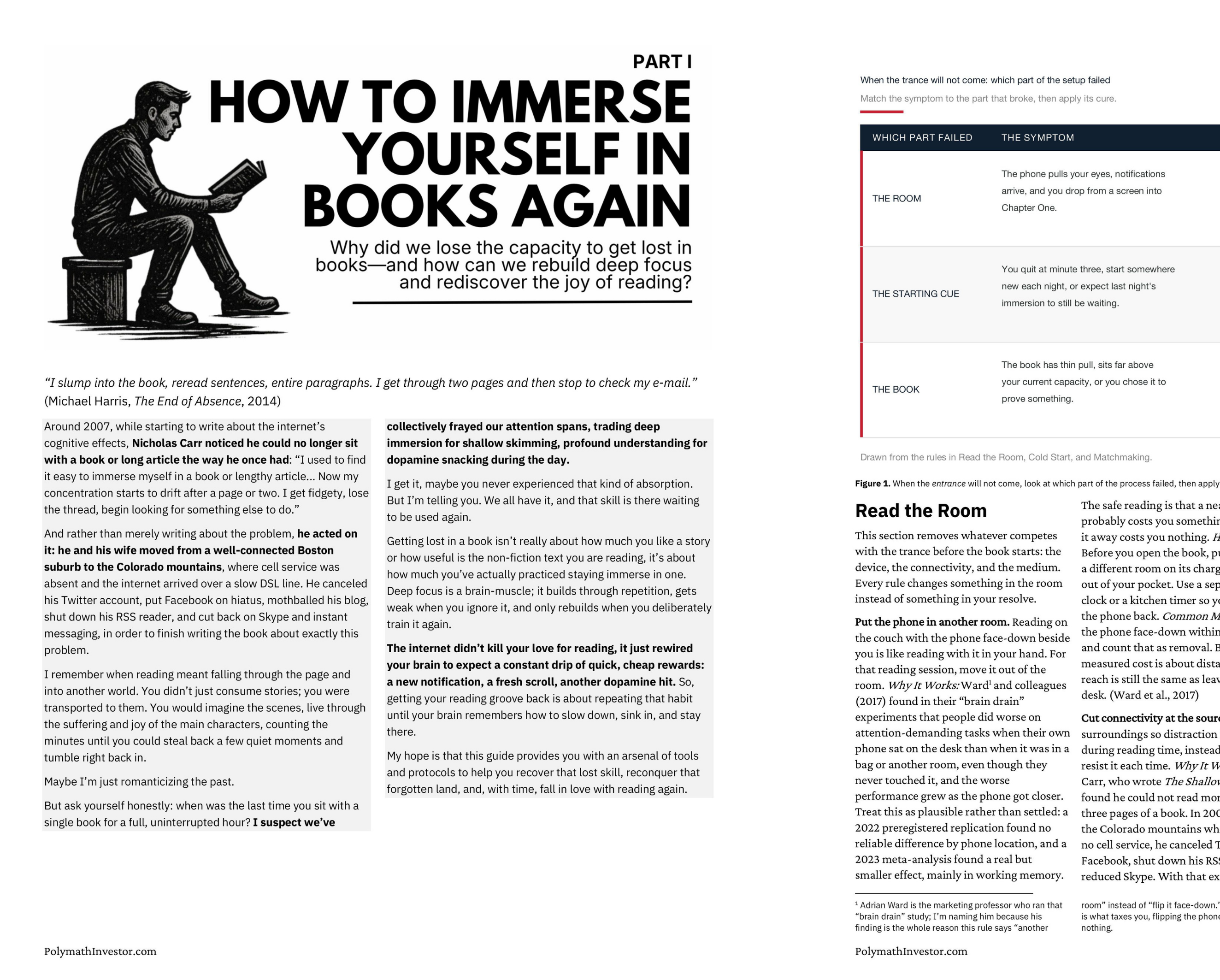
I’m not sure if anyone is reading this, but if you are, you probably know that feeling: you get curious about a random topic (maybe a new tech stack, behavioral psychology, or why certain stocks move the way they do), open 37 browser tabs (burn your RAM baby), read two paragraphs of each, get overwhelmed, and never touch it again. Honestly, I need to record a lot of stuff so I can remember it properly, and after reading a great breakdown from Polymath Investor, I decided to paraphrase and adapt their framework into my own style here.
The real bottleneck isn’t credentials or having 40 hours a week of free time. It’s knowing how to scope your questions, extract maximum insight from minimum reading, and connect new dots to things you already know.
1. Pick Questions That Are Actually Worth Your Time
Curiosity is your fuel when your brain is already half-fried after work. If a topic doesn’t genuinely bug you or excite you, don’t force it—you won’t last a week.
- Follow the itch, then narrow it down: Never start with a massive, vague goal like “learn everything about climate change” or “master Rust.” Turn it into a sharp, answerable question like “How does Polars handle lazy evaluation compared to pandas?”
- Run the “So what?” test: Ask yourself why the answer matters. Will it solve a problem at work, save you money, or give you a lasting mental model? If there is no real payoff, drop it or tweak the angle.
- Use your unfair advantage: Since you aren’t writing for an academic journal, explore weird intersections of things you already know. Combining your day-job skills with a random hobby often leads to insights specialists completely miss.
- Keep a question backlog: Maintain a running list of rabbit-hole ideas. Whenever a shiny tangent pops up mid-research, park it in the backlog so you don’t derail your current project.
Extra Example: Instead of trying to “research the Indonesian banking sector,” narrow it down to “How do digital banks in Indonesia maintain net interest margins compared to traditional state-owned banks?” Suddenly, you know exactly what numbers to look for.
2. Scope the Project Around Real Life
Adult life is unpredictable. Treat your personal research like an actual work sprint with hard boundaries, otherwise it will drag on forever.
- Start with the end deliverable: Decide upfront what “finished” looks like—a 5-page summary, a mind map, or a blog post like this one. That target dictates how deep you actually need to dig.
- Use the 80/20 rule: You are way better off deeply studying the top 2 or 3 seminal books or papers than skimming 15 mediocre blog posts.
- Time-box and slice into micro-tasks: Set a cap like “four evenings to gather sources, one weekend to write.” Break it into chunks you can knock out during a lunch break or before bed—skimming one article tonight, jotting down three takeaways tomorrow.
- Accept “good enough” coverage: Perfectionism is the enemy of finishing. Once you see the same core arguments repeating across your top 5 sources, stop digging and start wrapping up.
3. Filter Sources Without Overthinking It
You don’t need to fact-check every footnote like a PhD candidate, tho you still shouldn’t trust random clickbait at face value.
- Triangulate key facts: If three independent, reputable sources report the same finding, it’s probably solid enough to move forward.
- Prioritize long-half-life material: Favor books, deep-dive essays, and core concepts that will still be relevant a year from now over daily news noise.
- Use quick credibility filters: Check who wrote it and where it’s published. Scan the abstract, intro, and conclusion first—if it reads like an emotional rant with zero data or counterarguments, close the tab immediately.
4. Read for Leverage, Not Completion
You are not obligated to read every single page of a book or paper from cover to cover. Mine for answers instead.
- Skim wide, then drill deep: Survey 15–20 abstracts, tables of contents, or quick summaries first to map the landscape. Pick the 3 best sources and read those carefully.
- Read in layers: First pass: headings, charts, and summaries. Second pass: the specific chapters that answer your question. Third pass: only the dense, high-value sections.
- Use just-in-time learning: When you hit an unfamiliar term, look up just enough to understand the sentence (an LLM is great for a 30-second explanation) and jump right back in. Don’t let a minor definition turn into a three-hour detour.
5. Take Notes Your Future Self Can Actually Use
I don’t trust my brain to remember what I read last Tuesday, let alone six months from now. Writing things down isn’t optional.
- Write it in your own words: Copy-pasting quotes does nothing. Rephrase the core idea and note why it matters.
- Always attach context and source: A standalone note saying “Wheat yields plateaued in the 14th century” is useless next year. Add the why and the citation so you can trace it back later.
- Keep notes modular and linked: Stick to one clear idea per note, tag them, and link opposing or related viewpoints together (basically a lightweight Zettelkasten). Every month or so, review and prune dead links or duplicate thoughts.
6. Connect Dots Across Different Fields
The real fun starts when you take a concept from one domain and use it to unlock another.
- Look for structural analogies: Ask yourself, “What does this remind me of?” A feedback loop in ecology behaves a lot like a feedback loop in economics or machine learning.
- Use simple mental frameworks: You don’t need heavy academic theory—basic lenses like supply and demand, selection pressure, or systems vs. components give you an instant foothold in almost any new topic.
- Embrace being an outsider: Not knowing the “rules” of a new field lets you ask obvious questions insiders overlook. Just double-check whether your “breakthrough” idea hasn’t already been tested and debunked.
- Explain it out loud or in writing: Publishing a blog post or explaining your synthesis to a friend immediately exposes gaps in your logic.
7. Know When to Stop Digging
Independent researchers have to act as their own thesis advisor—and know when to say “enough.”
- Define “done” before you start: For example, “I’m done when I can explain the answer in a 10-minute talk without looking at my notes.”
- Fight the sunk-cost fallacy: If a line of inquiry turns out to be a dead end after two weeks, cut your losses and pivot. Spending more hours on a bad angle won’t magically make it useful.
- Ship a concrete deliverable: End every research sprint by producing something tangible—a summary, a diagram, or a post. It gives you closure and creates an artifact you can revisit later.
8. Keep Momentum Without a Boss Watching You
When nobody is grading your work, consistency beats raw willpower every single time.
- Make it a routine, but ride energy spikes: Block out a small recurring slot (even 30 minutes on Sunday night), and whenever you get a sudden burst of energy on a free afternoon, bank as much progress as you can.
- Alternate heavy and light tasks: After wrestling with a dense paper tonight, spend tomorrow’s session doing low-friction work like organizing notes or watching a related talk.
- Build lightweight accountability and reward yourself: Tell a friend or partner you’ll share what you learned by Friday. When you finish a big milestone, treat yourself to good food or a guilt-free gaming session.
9. Build Your Personal Research Playbook
Treat every research project as an experiment. Reflect on what worked (maybe morning reading beats late-night reading for you), accept dead ends as part of the process, and build a diverse “knowledge portfolio”—some projects purely for fun, others to sharpen career skills.
Over time, you can even build your own research infrastructure: a small circle of smart peers who can compress weeks of reading into one coffee chat, plus a repeatable pipeline for turning messy notes and raw data into clean outputs.
Conclusion: Start Small and Ship Something
You don’t need to quit your job or go back to university to develop genuine expertise. Pick one nagging question tonight, time-box it to two weeks, and commit to publishing a short summary of what you find.
That’s all for today, folks! Thanks for reading—and huge credit to Polymath Investor for the original framework. I’ll catch you in the next post.
“The only thing that interferes with my learning is my education.”
– Albert Einstein

Leave a comment