
Gemini 4 Hydrogen: Speed, Efficiency, and Agentic Execution
Released by Google DeepMind on November 12, 2026, Gemini 4 Hydrogen (gemini-4-hydrogen) is Google’s high-speed, cost-efficient execution model built for everyday software engineering, multimodal knowledge work, and multi-step AI agents.
What is Gemini Hydrogen?
Gemini 4 Hydrogen is a distilled, latency-optimized member of the Gemini 4 model family, adapted directly from Google’s flagship frontier reasoning model, Gemini 4 Carbon. While Carbon and Argon are engineered for deep, long-horizon theoretical and security research, Hydrogen is designed to deliver frontier-adjacent intelligence at rapid speeds and lower token costs.
Key technical specifications from the official Google DeepMind Model Card and API documentation include:
- Unified 1M-Token Context Window: Supports up to 1,048,576 tokens across combined input, reasoning, and output.
- Long Decode Architecture: Generates up to 65,536 (64K) tokens in standard synchronous mode and up to 1M tokens asynchronously via background Long Decode.
- Native Multimodality: Processes text, code, images, audio, video (including agentic video understanding), and PDFs natively.
- Four Tunable Thinking Levels: Introduces an
xhigh(Extra High) reasoning mode alongsidelow,medium, and the defaulthigh, giving developers granular control over the trade-off between latency, token spend, and reasoning depth. - Flat API Pricing: Priced at $1.50 per 1M input tokens and $7.50 per 1M output tokens across the entire 1M context window (with a rate-limited free tier in Google AI Studio).
What is it for?
Gemini 4 Hydrogen is purpose-built for high-throughput, interactive, and agentic workloads where waiting tens of minutes for a heavyweight frontier model is impractical:
- Multi-Agent Orchestration (Worker & Verifier Roles): In platforms like Google Antigravity, Hydrogen pairs with Gemini 4 Carbon—Carbon handles high-level architectural planning, while parallel Hydrogen sub-agents simultaneously write code, run tests, and triage issues across isolated workspaces.
- Rapid Prototyping & Web Development: Built for live UI prototyping, design-to-code iteration, and interactive browser apps or games, producing functional layouts in fewer prompts.
- Enterprise Document & Spreadsheet Workflows: Excels at parsing dense tables and automating financial modeling. In Google Sheets, Hydrogen generates dynamic forecasting models over 30% faster than prior models, and in Box’s enterprise evaluations, it ran roughly 2x faster while using 12% fewer tokens than Gemini 3.8 Flash.
- Consumer Search & Everyday Assistance: Powers global responses in Google Search and the Gemini app, pairing fast response times with refined safety tuning that keeps false refusals on legitimate medical/scientific queries under 0.4% on HealthBench Pro.
What is the difference compared to other versions?
Within Google’s ecosystem, Gemini 4 Hydrogen bridges the gap between ultra-fast lightweight models and heavy frontier reasoning models:
1. Hydrogen vs. Gemini 3.8 Flash (Direct Upgrade Path)
Google explicitly positions gemini-4-hydrogen as the recommended upgrade for developers migrating off gemini-3.8-flash:
- Speed & Coding Leap: At its default
highthinking level, Hydrogen completes tasks up to 2.5x faster than Gemini 3.8 Flash while more than tripling performance on terminal engineering tasks (57.0% vs. 18.2% on Terminal-Bench 4.1). - Reasoning Jump: Climbs from 31 (3.8 Flash) to 51 (Hydrogen
high) and 54 (Hydrogenxhigh) on the Artificial Analysis Intelligence Index v5.0.1. - Alignment & Security Hardening: Cuts agentic overreach by up to 81%, reduces under-service by 79%, lowers misaligned tool-use actions by 12x, preserves 99.9% chain-of-thought legibility across 200,000+ audited turns, and achieves >2.3x higher resilience against indirect prompt injection on the Gray Swan IPI benchmark.
- Cost Trade-off: Hydrogen’s $1.50 / $7.50 per 1M token rate is double Gemini 3.8 Flash’s introductory pricing ($0.75 / $3.75), though it matches Flash’s scheduled standard pricing effective January 1, 2027.
2. Hydrogen vs. Gemini 4 Carbon, Argon, and 3.5 Flash-Lite
| Model | Model ID | Primary Role | AA Intelligence Index | API Pricing (In / Out per 1M) | Context Window |
|---|---|---|---|---|---|
| Gemini 4 Hydrogen | gemini-4-hydrogen |
Fast execution, coding & parallel agents | 51 (high) / 54 (xhigh) |
$1.50 / $7.50 (flat) | 1M tokens |
| Gemini 4 Argon | gemini-4-argon |
Mid-tier long-horizon reasoning | 50 (high) |
$2.00 / $10.00 ($4/$20 std) | 1M tokens |
| Gemini 4 Carbon | gemini-4-carbon |
Flagship frontier reasoning & cyber defense | 59–60 (high) |
$2.00 / $10.00 ($4/$20 std) | 1M tokens |
| Gemini 3.5 Flash-Lite | gemini-3.5-flash-lite |
High-volume routing & sub-second latency | Lightweight tier | Ultra-low cost tier | 1M tokens |
Notably, Hydrogen (high) slightly edges out Gemini 4 Argon on general intelligence benchmarks while costing less per token and finishing index evaluations roughly 3.7x faster (7.9 minutes vs. 29.4 minutes), reserving Gemini 4 Carbon for the hardest root-cause debugging and vulnerability discovery tasks (SEC-bench Pro 88.2%).
Comparison with Sonnet (Claude Sonnet 5.5)
When stacked against Anthropic’s Claude Sonnet 5.5 (released September 28, 2026), both models target the sweet spot of everyday developer and enterprise productivity with 1M-token context windows—but each leads in distinct areas.
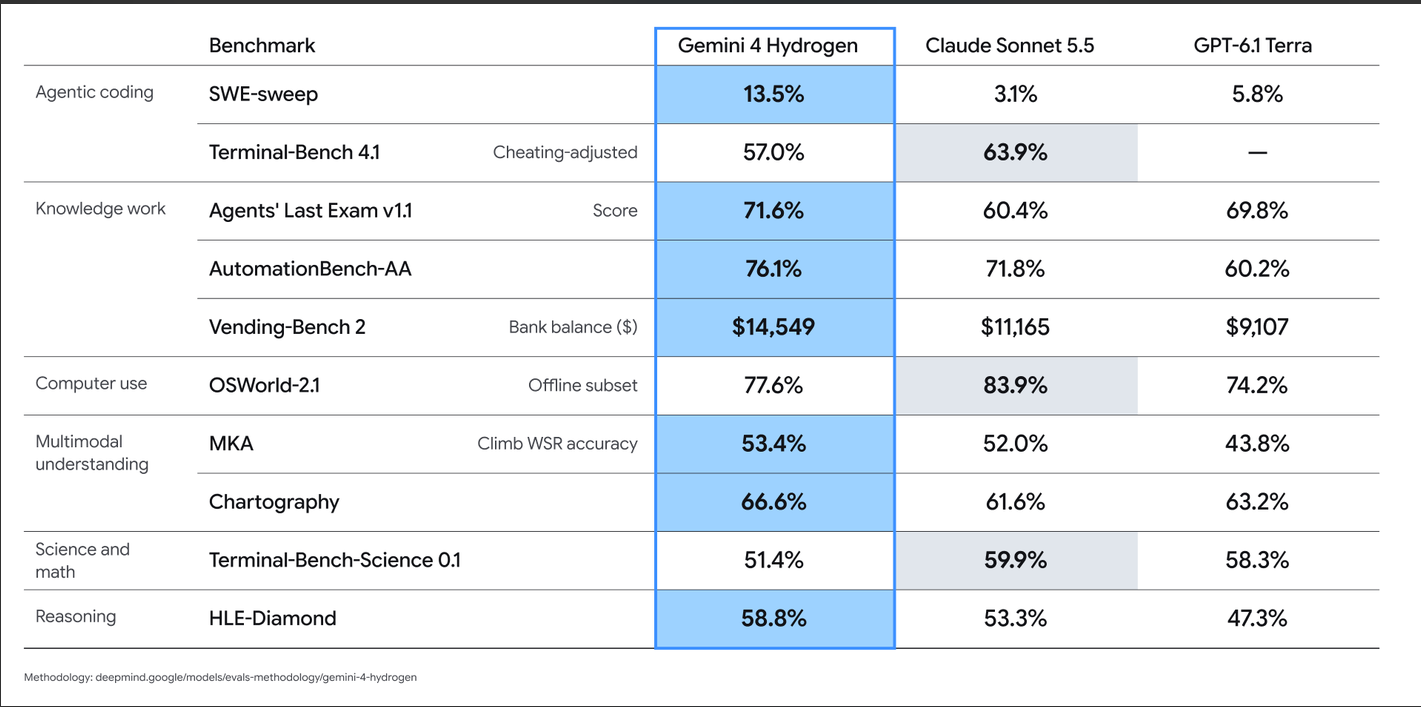
Head-to-Head Metrics & Benchmarks
| Metric / Benchmark | Category | Gemini 4 Hydrogen | Claude Sonnet 5.5 | Advantage |
|---|---|---|---|---|
| API Input / Output Price | Cost (per 1M tokens) | $1.50 / $7.50 | $2.00 / $10.00 | Gemini 4 Hydrogen (25% cheaper) |
| AA Intelligence Index v5.0.1 | Independent Composite | 51 (high) / 54 (xhigh) |
55 (max) |
Claude Sonnet 5.5 (+1 to +4 pts) |
| Time per Index Task | End-to-End Speed | 7.9 min (high) |
34.1 min (max) |
Gemini 4 Hydrogen (~4.3x faster) |
| SWE-sweep | Multi-file Code Sweeps | 13.5% | 3.1% | Gemini 4 Hydrogen |
| Agents’ Last Exam v1.1 | Agentic Knowledge Work | 71.6% | 60.4% | Gemini 4 Hydrogen |
| AutomationBench-AA | Workflow Automation | 76.1% | 71.8% | Gemini 4 Hydrogen |
| HLE-Diamond | Hard Reasoning | 58.8% | 53.3% | Gemini 4 Hydrogen |
| Chartography | Chart & Visual Understanding | 66.6% | 61.6% | Gemini 4 Hydrogen |
| Terminal-Bench 4.1 | CLI / Shell Engineering | 57.0% | 63.9% | Claude Sonnet 5.5 |
| OSWorld-2.1 (Offline) | Desktop GUI Computer Use | 77.6% | 83.9% | Claude Sonnet 5.5 |
| Terminal-Bench-Science 0.1 | Scientific Computing | 51.4% | 59.9% | Claude Sonnet 5.5 |
Key Takeaways & Research Nuances
- Cost & Turnaround Speed: Gemini 4 Hydrogen undercuts Claude Sonnet 5.5 by 25% on raw token pricing and completes full benchmark suites in a fraction of the wall-clock time (7.9 minutes at
highvs. 34.1 minutes for Sonnet 5.5 atmax). - Workload Specialization: In Google’s published launch benchmarks, Hydrogen outperforms Sonnet 5.5 on 7 out of 10 evaluations—particularly in business workflow automation (
AutomationBench-AA), repository-wide sweeps (SWE-sweep), and multimodal chart analysis. Conversely, Claude Sonnet 5.5 remains stronger at interactive shell execution (Terminal-Bench 4.1) and desktop GUI navigation (OSWorld-2.1). - Independent Research Caveats: Independent analysis from Artificial Analysis and NeuralTrust notes that while Hydrogen’s
xhighsetting pushes its Intelligence Index score to 54 (nearly matching Sonnet 5.5’s 55), it becomes substantially more verbose (generating 304M output tokens across the full index vs. 110M athigh), raising per-task cost from $1.87 to $3.16. Furthermore, developer discussions on Google’s AI Forum highlight that cross-model SWE scores rely partly on different agent harnesses (such as Antigravity-CLI), advising teams to validate on proprietary codebases before migrating.
References & Research Cited
- Google DeepMind (Nov 12–13, 2026): Gemini 4 Hydrogen Model Card & Evaluation Methodology — deepmind.google/models/model-cards/gemini-4-hydrogen
- Google Blog (Nov 12–13, 2026): Introducing Gemini 4 Hydrogen for Agentic Workflows — blog.google/innovation-and-ai/models-and-research/gemini-models/introducing-gemini-4-hydrogen
- Google AI Studio Documentation (Nov 2026): What’s new in Gemini 4 Hydrogen — aistudio.google.com/docs/whats-new-gemini-4-hydrogen
- Artificial Analysis / NeuralTrust (Nov 13, 2026): Gemini 4 Hydrogen: Benchmarks & Security (Intelligence Index v5.0.1) — neuraltrust.ai/blog/gemini-4-hydrogen
- BenchLM (Nov 13, 2026): Claude Sonnet 5.5 vs. Gemini 4 Hydrogen Evaluation — benchlm.ai/compare/claude-sonnet-5-5-vs-gemini-4-hydrogen
- Google AI Developer Forum (Nov 13, 2026): Gemini 4 Hydrogen: Cross-Model Evaluation Parity & Reproducibility Discussion — discuss.ai.google.dev



Leave a comment